Wednesday, August 16, 2023

Hacker Creates Memecoin with Proceeds from RocketSwap Hack

Decentralized crypto exchange RocketSwap was hacked yesterday 15 August by an unknown attacker. As a result, 741 ETH (about $870,000) was lost, after which the hacker sent the funds to Ethereum and created a memecoin, LoveRCKT.

According to the RocketSwap team, the attack was as a result of a series of lapses, one of which was use of offline signatures in the launchpad deployment, and a decision to store private keys on the server.

The team has since apologized to users in an update on the situation on RocketSwap official Twitter handle.

“We are sorry to inform you that the team needed to use offline signatures when deploying the launchpad and put the private keys on the server. A brute force hack of the server was detected, and due to the proxy contract used for the farm contract, there were multiple high-risk permissions that led to the transfer of the farm’s assets,” it said.

Some social media users have accused the team of carrying out a rug pull. For example, a Twitter user wrote:

“Yeah, it wasn’t at ALL them who rugged it twice in one week. Give me a break. Why would they change the proxy literally right before it happened then completely act like it’s not a big deal? Use your head.”

However, the team has maintained that the attack was the work of an external attacker who executed a brute force assault on a cloud server used by the project. The attack then allowed the attacker to access private keys, making it possible to transfer assets from the exchange’s yield farm.

Attacks on Base Layer 2

Base is a Layer 2 network was recently launched by Coinbase on Ethereum. The blockchain offers a safe, low-cost, developer-friendly way to build on-chain. Because of the attractive features it offers, it already has projects like RocketSwap launching on it.

The attack on RocketSwap was unprecedented, and happens to be the second significant attack on the network, the first being the attack on another DEX, LeetSwap, which led to the loss of $630,000 on July 31.

According to the update on Twitter, the team has taken immediate action to prevent further losses by shutting down the yield farm.

“We shut down the farm to prevent further damage. The team is currently working on an emergency plan and the Telegram group has been banned for the time being. The loss of farm assets is only a concern, DEX is not affected in any way. We are very sorry for your loss,” the team further stated.

The new memecoin

Following the hack, the attacker moved the stolen assets from the Base blockchain to Ethereum and quickly created a memecoin named LoveRCKT, details from blockchain security firm PeckShield indicate.

The new memecoin was paired with 400 ETH of liquidity on Uniswap, and the price quickly tripled within just 24 hours, rising from $0.00000001 to $0.00000003 despite being deployed by a hacker. It however later dropped by more than 90% in what appeared to be a rug pull.

The exploiter has also sold 2.5 trillion LoveRCKT tokens for 20.33 WETH, PackShield further stated in a Twitter update. Meanwhile, the token is still listed on Dexscreener and trading as at the time of reporting the story.

The post Hacker Creates Memecoin with Proceeds from RocketSwap Hack first appeared on CryptocyNews.com.


from CryptocyNews.com https://www.cryptocynews.com/hacker-creates-memecoin-with-proceeds-from-rocketswap-hack/
via Bitcoin News
via Bitcoin News Today

Monday, August 14, 2023

PayPal to Launch Member-Only Crypto Hub Following Stablecoin Launch

Payment giant PayPal is entering the crypto space in a big way. Shortly after launching its USD-pegged, Ethereum-based stablecoin PYUSD, the company has announced plans to launch a crypto hub for select users.

PayPal updated its terms and conditions to introduce Cryptocurrencies Hub, which will allow users to hold and interact with Bitcoin and other cryptocurrencies right in their PayPal account.

Specifically, the updated terms of use outline the conditions for users interested in using the platform for cryptocurrencies. 

Among other things, the hub will allow users to buy and sell cryptocurrencies, as well as facilitate the payment for purchases via PayPal using the money stored after the sale of cryptocurrencies.

Other features of the hub include the ability to hold crypto assets, convert between PYUSD and other crypto assets, sending and receiving crypto assets, and crypto market information and educational content.

Not everyone will be able to access the features on the platform though. PayPal will decide from person to person, based on the condition that the person must have “a personal PayPal account and a Balance Account in good standing.” 

The prospective user will also need to complete KYC by providing information such as name, physical address, date of birth, and taxpayer identification number. 

“You can only use your Cryptocurrencies Hub as part of your Balance Account by accessing it through your personal PayPal account. If you are a Hawaii resident, we will not allow you to establish a Cryptocurrencies Hub at this time,” the terms stated.

A big step for PayPal

PayPal may have seen cryptocurrencies as a competition initially, but those days are long gone. The company has now decided to identify with cryptocurrencies, and it started by allowing the buying and selling of cryptocurrencies a few years ago.

The latest move was the launch of its stablecoin, PYUSD, which although has faced much criticism, is considered a big step towards mainstream adoption of cryptocurrencies in general. The Cryptocurrency Hub project is another way of demonstrating PayPal’s commitment to becoming a crypto inclusive platform.

By enabling the buying, selling as well as swapping of crypto assets, the company only slightly falls short of being a crypto exchange, which makes it an important part of the crypto space now. 

Cryptocurrency Hub could encourage PYUSD adoption

PayPal’s stablecoin PYUSD has faced a lot of resistance, and experts predict it may have a hard time seeing massive adoption. This is because of existing stablecoins such as USDT and USDC, which have already taken a significant portion of the stablecoin market.

Another hindrance to the stablecoin’s adoption is the creation of central bank digital currencies (CBDCs) which are meant to be used for similar purposes as stablecoins. It is also noteworthy that countries that don’t want to create CBDCs are opting for national stablecoins, further worsening the competition.

However with the Cryptocurrency Hub launch by PayPal, PYUSD adoption may significantly improve, especially because of the PYUSD swap feature. By allowing users to swap PYUSD and other crypto assets, users will be compelled to use the stablecoin.

This is also likely to increase the likelihood of exchanges listing the stablecoin on top exchanges, which experts say is a condition for significant adoption. Clearly, PayPal still has a lot in store to roll out in the crypto space, which is also a sure way for PYUSD to gain adoption.

The post PayPal to Launch Member-Only Crypto Hub Following Stablecoin Launch first appeared on CryptocyNews.com.


from CryptocyNews.com https://www.cryptocynews.com/paypal-to-launch-member-only-crypto-hub-following-stablecoin-launch/
via Bitcoin News
via Bitcoin News Today

SpearGPT Review – Is Speargpt.com a Legit Crypto Broker?

SpearGPT Review

SpearGPT is a retail trading brand offering crypto CFDs, on top of other well-known financial markets. The growing demand for crypto trading incentivizes companies like this one to step up their game and provide competitive terms.

An increasing number of traders are talking about SpearGPT these days, and if you haven’t heard of this broker yet, this review can be a valuable source of information for you. In case you are also interested in crypto trading and professional trading terms, make sure to stick around until the end, because it will really help you make your mind up about SpearGPT.

Trading Crypto With SpearGPT

Crypto Trading with SpearGPT

Cryptocurrencies have been a source of intrigue for investors for the last couple of years. Because these are volatile instruments, it’s possible to find buying and selling opportunities on a regular basis. This broker is well aware of that, apparently.

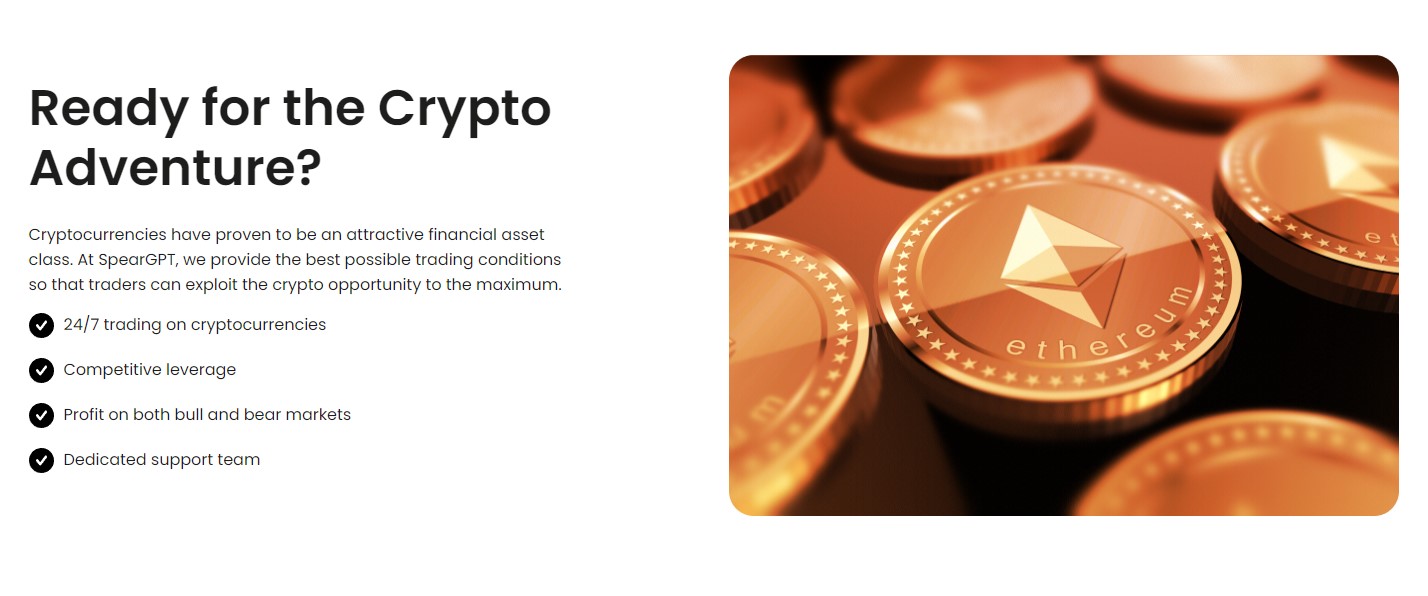
SpearGPT has a dedicated crypto section on its website, where it offers all the details you need on the trading conditions available. You can trade digital assets 24/7 using competitive leverage and with the help of a dedicated support team. Among the coins covered, Bitcoin, Ether, Litecoin, Cardano, Binance Coin, Dogecoin, Dash,  and Solana stand out. Plenty of other names are part of the offering, ensuring a great deal of diversification.

Traders have access to other popular markets as well, including currencies, shares, indices and commodities. These are also in the form of CFDs, carrying tight spreads and fast trade execution.

Platforms Covered

A web-trading platform is an ideal choice when trading on the go from multiple devices, because it is flexible. You don’t need to install any software and you can log into your account quickly. SpearGPT offers such a platform, promising a large array of analysis tools. It doesn’t matter if you are not accustomed to trading yet, because this is a user-friendly solution.

MetaTrader 4 is part of the picture as well and in this case, you can access advanced trading tools, a friendly interface and multi-device compatibility. There’s no need to worry about complexity, since the platform is very intuitive.

SpearGPT Trading Features

Account Benefits

Before talking about the trading account benefits available with SpearGPT, you should first decide on the right type account for you. The broker offers several accounts, catering to the needs of a global audience.

SpearGPT Logo

However, we should highlight that traders are favored in terms of trading conditions, which look optimal at every level. You can access professional support, use leverage up to 1:200, benefit from tight spreads and incorporate up to 1,500 instruments in your trading regime. If you need further guidance on how to open a live account, SpearGPT offers customer support around the clock.

Ending Thoughts

Trading crypto with SpearGPT seems like a good choice, based on the current features provided by the broker. You have access to a generous list of coins, tradable using leverage and tight spreads. The platforms available with this brand are easy to use and secure, enabling you to operate calmly. As you progress in your trading journey, it’s also possible to make an account upgrade in order to receive more competitive features.

The post SpearGPT Review – Is Speargpt.com a Legit Crypto Broker? first appeared on CryptocyNews.com.


from CryptocyNews.com https://www.cryptocynews.com/speargpt/
via Bitcoin News
via Bitcoin News Today

Saturday, August 12, 2023

Paypal’s PYUSD May Have a Hard Time Getting Adopted – BoA

The Bank of America says PayPal’s newly launched stablecoin, PYUSD may have a hard time getting adoption, at least in the short term. The bank stated this in a report based on recent research it carried out concerning the stablecoin.

First, PYUSD is likely to face intense competition, according to the bank’s analysts, Alkesh Shah and Andrew Moss, and one of the sources of competition will be central bank digital currencies

Central bank digital currencies (CBDCs) are becoming a big deal, as countries around the world seek to create alternatives to cryptocurrencies, with the same speed and efficiency.

“Over the longer term, we expect PYUSD to experience additional adoption headwinds as competition from central bank digital currencies (CBDCs) and yield-bearing stablecoins increases,” the Bank of America said in its report.

Many countries are at different levels of their CBDC projects, while others have already launched. The ones that come to mind are China, Russia, Brazil, South Korea, Japan, and the UK, while countries like Nigeria have already launched their own CBDCs.

CBDCs serve as digital versions of national fiat currencies, and can be used for exactly the same purposes as stablecoins like PYUSD, making the competition more fierce.

Competition from other stablecoins

Existing stablecoins such as USDT and USDC are also likely to create a massive competition against PYUSD. This is because they have been in circulation for years, and the public has already gotten used to them.

For example, USDT alone bears over 64% of the total stablecoin market share, and there are a few other less known ones, making it difficult for PYUSD to get a piece of the pie, unless it offers something different to what these ones are offering.

According to the BoA report, yield-bearing stablecoins will likely become more available and attractive, which PYSUD is not.

“Investors may have been fine holding non-yield bearing stablecoins, such as USDT and USDC, when rates were close to zero, but yield-bearing stablecoins will likely become increasingly available and attractive with short-term rates above 5%.”

Perhaps a more obvious hindrance to PYUSD’s adoption is that it came at a time when the crypto industry has come under intense pressure in the U.S. Top crypto exchanges like Coinbase and Binance are in court for allegedly violating securities law violations.

Even more interesting is the fact that stablecoins have become of particular interest to regulators and lawmakers since the TerraUSD incident. As a result, the U.S. is seeking a comprehensive and more rigid regulatory framework for stablecoins in particular.

This could further reduce the chances of PYUSD making it to the mainstream, especially if stablecoin issuance becomes restricted to banks.

“Investors are likely indifferent to which stablecoins they hold as long as the stablecoins are perceived as safe and accessible on the largest trading platforms. We do not expect PYUSD’s launch to lead to accelerated regulatory clarity, given the stablecoin’s issuance does not alter systemic risk for traditional markets, but the stablecoin may face regulatory headwinds if non-banks are ultimately barred from stablecoin issuance,” the report added,

PYUSD could compete

Payment giant PayPal launched PYUSD last week, and since then, many views have been expressed concerning the stablecoin. One of the views is that PYUSD can compete with existing stablecoins, but it has to get listed on major exchanges to do this.

Since then, Huobi Global, one of the leading global exchanges has shown interest in listing it. If more top exchanges list it, the stablecoin may be able to find its place in the stablecoin market.

The post Paypal’s PYUSD May Have a Hard Time Getting Adopted – BoA first appeared on CryptocyNews.com.


from CryptocyNews.com https://www.cryptocynews.com/paypals-pyusd-may-have-a-hard-time-getting-adopted-boa/
via Bitcoin News
via Bitcoin News Today

Thursday, August 10, 2023

India Challenges Citizens to Build Crypto-Powered Native Web Browser

The Indian ministry of Electronics & Information Technology (MeitY) has challenged its citizens to develop a native web browser powered by crypto tokens. The ministry announced the launch of the Indian Web Browser Development Challenge (IWBDC) on 9August, in which participants will compete for the web browser.

“The IWBDC is an Open Challenge Competition that seeks to inspire and empower technology enthusiasts, innovators, and developers from all corners of the country to create an indigenous web browser with its own trust store with an inbuilt CCA India root certificate, cutting edge functionalities and enhanced security & data privacy protection features,” the ministry said in a statement.

The web browser is to have as a key feature, the ability to sign documents digitally using a crypto token. The goal is to enhance the security of transactions and digital engagements, and it will mark a significant step towards achieving India’s much sought technological independence.

India, through the Controller of Certifying Authorities (CCA), Shri Arvind Kumar, is working hard to ensure that digital certificates issued within the country are secure. Kumar is also actively contributing towards developing a robust Public Key Infrastructure (PKI) framework that would enable secure electronic transactions throughout the nation.

By integrating India Root Certificate into the upcoming national browser, India will address the issue of making the country more “Internet Resilient”, as well as eliminate the need for the Secure Sockets Layer (SSL) certificates issued by foreign entities.

India embracing technology

India ranks among the most anti-crypto countries in the world. Like Nigeria, China, and other countries, India has attempted to place a blanket ban on cryptocurrency, although the bill could not succeed.

Subsequently, the country has made laws that are discouraging to crypto traders and investors, including the 30% tax on crypto returns, which has already been implemented. In fact, it is one country that has been pressing for crypto regulation at G-20 summits, although this is yet to see the light o day.

One thing the government has admitted though, is the potential of blockchain – the technology that underpins cryptocurrencies – to be used for financial and other innovations. It seems the country is finally wake up to harness the technology for its technological advancement.

Sunita Verma, a Scientist G & GC (R&D in Electronics & IT) said digital India has positively impacted overall governance.

“Digital India has revolutionized how our nation functions, empowering citizens, boosting the economy and enhancing overall governance. As we move forward, embracing technology and promoting indigenous innovation will be pivotal in realizing the vision of a self-reliant, digitally empowered India,” Verma said in a statement.

By engaging Indian scientists in this challenge, India is taking a big step towards raising a crop of scientists that can effectively drive technological innovation that will bring about self-reliance.

$400,000 to be won

The challenge will come in three phases. In the first, 18 participants will be chosen, who will then be shortlisted to 8 in the second, and only 3 coming to the final round. The winner will receive 34 million Indian rupees (around $411,000), plus additional support for developing the browser.

Participants will be drawn from all sectors of the economy, including academia, industry, start-ups, or individuals. All interested Indian citizens are encouraged to submit an idea for the innovative Indian web browser that could cater to a global audience.

The post India Challenges Citizens to Build Crypto-Powered Native Web Browser first appeared on CryptocyNews.com.


from CryptocyNews.com https://www.cryptocynews.com/india-challenges-citizens-to-build-crypto-powered-native-web-browser/
via Bitcoin News
via Bitcoin News Today

Wednesday, August 9, 2023

Binance Obtains El Salvador’s Crypto Exchange License 

An official report issued , on August 8, revealed that El Salvador’s central bank had approved Binance’s license to operate as a regulated entity. The report illustrated that Binance obtained a Bitcoin Service Provider License (BSP) and Digital Asset Service Provider (DASP).

The approval of the Binance license grants the crypto exchange the authority to provide custodial services and facilitate crypto payments. Soon the Binance team will officially offer digital wallets and exchange services to Salvadorians.

Binance Expands to El Salvador

Remarkably, the licensing came when El Salvador sought to create a friendly environment for crypto and attract key investors to the region. A statement issued by Binance Central America general manager Daniel Acosta revealed that licensing enables the crypto exchange to broaden its geographic presence to the region.

Acosta was pleased to announce the regulatory approval challenges Binance to tailor its products and services according to the needs of the Salvadorians.

In support of Acosta’s statement, Binance’s head of Latin America, Min Lin, confessed that the licensing process was thorough. The executive added that securing the license took several months.

Irrespective of this, Salvadorian president Nayib Bukele has been pushing for a crypto-friendly country. President Bukele has greenlighted several policies that will support the growth of the crypto sector.

In early January, President Bukele signed the Digital Securities bill into law, which outlines the legal framework for launching the government bond centered on the Bitcoin network. Subsequently, the president led Salvadorian public agencies to establish a crypto regulatory agency dubbed the National Commission of Digital Assets (NCDA).

Binance ranks second crypto firm to receive digital assets license under the NCDA regulatory regime. In April, Bitfinex received the license approval to offer trading tokenized equities to Salvadorian residents. Besides Binance, the suitability of the El Salvador crypto market continues to attract key players from across the globe.

Binance Faces Charges

Reportedly the Binance expansion to Latin America came when the crypto exchange faced potential action from different regulators. Last month the US Securities and Exchange (SEC) filed a lawsuit against Binance and the chief executive, Changpeng Zhao, for violating the securities regulations.

According to SEC, the Binance top executives, led by the CEO, misappropriated company funds aiming at enriching themselves. 

Consecutively Binance has been battling intensive regulatory pressure in different jurisdictions. As the legal action continued, the troubled crypto exchange fled from the Netherlands, Germany, and Austria to pursue other suitable markets overseas.

Despite the legal charges facing Binance, the crypto exchange has invested heavily in broadening its market presence to maintain its position in the crypto space. A few days ago, Binance secured a crypto asset provider license from UAE regulators.

With the approval of the UAE license, the Binance team will offer crypto brokerage and dealership services to qualified institutional investors.

The post Binance Obtains El Salvador’s Crypto Exchange License  first appeared on CryptocyNews.com.


from CryptocyNews.com https://www.cryptocynews.com/binance-obtains-el-salvadors-crypto-exchange-license/
via Bitcoin News
via Bitcoin News Today

Tuesday, August 8, 2023

CoinsPaid Suspects Lazarus Group Stole $37M through Fake Job Interview

In a recent update, the prominent crypto payment platform in Estonia, CoinsPaid, accused the North Korean illicit group of compromising with the company system. The CoinsPaid team lamented that the Lazarus Group gained unauthorized access to the system and posted fake jobs.

In a blog post dated August 7, the CoinsPaid team stated that the bad players exploited a vulnerable system to heist over $37 million as of July 22.

Hackers Exploits CoinsPaid System

The report stated that the suspects tricked the job seekers into downloading suspicious software while undergoing the recruitment process. According to CoinsPaid, the hackers’ dubious scheme involved completing several stages of the recruitment process. 

At the technical assessment stage, the applicants were prompted to download software redirecting them to complete the online recruitment tests. In the primary phase of the online application, the job seekers confessed that they were forced to download malicious code to proceed with the subsequent hiring process.

After downloading the code, the CoinsPaid team lamented that the unscrupulous players gained access to applicants’ data. Later the hackers leveraged their vast technical experience to enable the applicants to access CoinsPaid data and system.

The troubled crypto payment platform also admitted that the hackers weakened the system’s vulnerability to gain complete access to CoinsPaid infrastructure. The hackers proceeded with the suspicious scheme to create a backdoor on the CoinsPaid platform.

CoinsPaid Seeks to Restore Stolen Funds

Besides gaining unauthorized access, the hackers leveraged their expertise to familiarize themselves with the CoinsPaid system. From understanding the fundamental concepts and operations of CoinsPaid, the hackers launched legitimate requests on the interaction interface with the blockchain network. Subsequently, the hackers withdrew a measurable amount of company assets locked in the operational storage vault.

The unexpected withdrawal of huge funds compelled the CoinsPaid team to invest in probing the matter. The CoinsPaid team entered into a partnership agreement with Match System to restore the stolen assets.

In a July 26 post-mortem report, the probing team observed that the exploit was undertaken by the world’s most powerful cybercrime organization Lazarus Group. The CoinsPaid report demonstrated that the hackers had made several attempts to exploit the weak protocols in March.

The failed attempts challenged the Lazarus Group to up its game and leverage its social engineering expertise to target the employees instead of the crypto payment company.In addition, CoinsPaid and Match System observed that a significant amount of the stolen funds were transferred through SwftSwap.  

The said transfers were wired in USDT to Ethereum, Bitcoin, and Avalanche networks. Also, the lost asset was transferred to Atomic Wallets, according to CoinsPaid statement.

Even though the CoinsPaid team has not managed to restore the stolen funds, the probing team has implemented operational measures to block and freeze the funds. The CoinsPaid team has also informed other exchanges on the matter. The crypto payment platform in distress has obtained the hacker’s addresses to trace any suspicious transactions.

The post CoinsPaid Suspects Lazarus Group Stole $37M through Fake Job Interview first appeared on CryptocyNews.com.


from CryptocyNews.com https://www.cryptocynews.com/coinspaid-suspects-lazarus-group-stole-37m-through-fake-job-interview/
via Bitcoin News
via Bitcoin News Today